



Photo by Richard Hurd
Metro Metrics January 2026

Metro Metrics is a monthly data snapshot that explores key economic indicators reflecting the health of the Madison metro economy.
Tracking Regional Workforce Housing
Available housing supply has been a challenge in the Madison region for years. A 2019 report by the Wisconsin REALTORS® Association found that Dane County underproduced more than 11,000 housing units from 2006 to 2017. And the Dane County Regional Housing Strategy concluded that the county needs to produce at least 7,000 new housing units per year for supply to keep up with demand.
This month’s edition of Metro Metrics takes a look at recent data to assess our collective progress on this issue.
Madison’s Apartment Market
One source the Chamber uses for housing data is CoStar. This database of commercial properties helps us analyze trends in apartment rental markets across the country.
In 2025, the Madison Metro added a net 2,802 multi-family housing units, an increase of 2.8%. Effects of this added supply include a modest increase to the region’s vacancy rate from 5.9% to 6.2% and a reduction to the region’s year-over-year asking rent price growth from 2.5% to 1.4% (Fig. 1).
A clear correlation can be seen between vacancy rate and rent growth. When vacancy rates dip below 4%, as they did in 2020 and 2021, rent increases typically follow. Now that vacancy rates in the region have begun increasing again, rent growth has dropped down to its typical 1-2%-per-year rate.
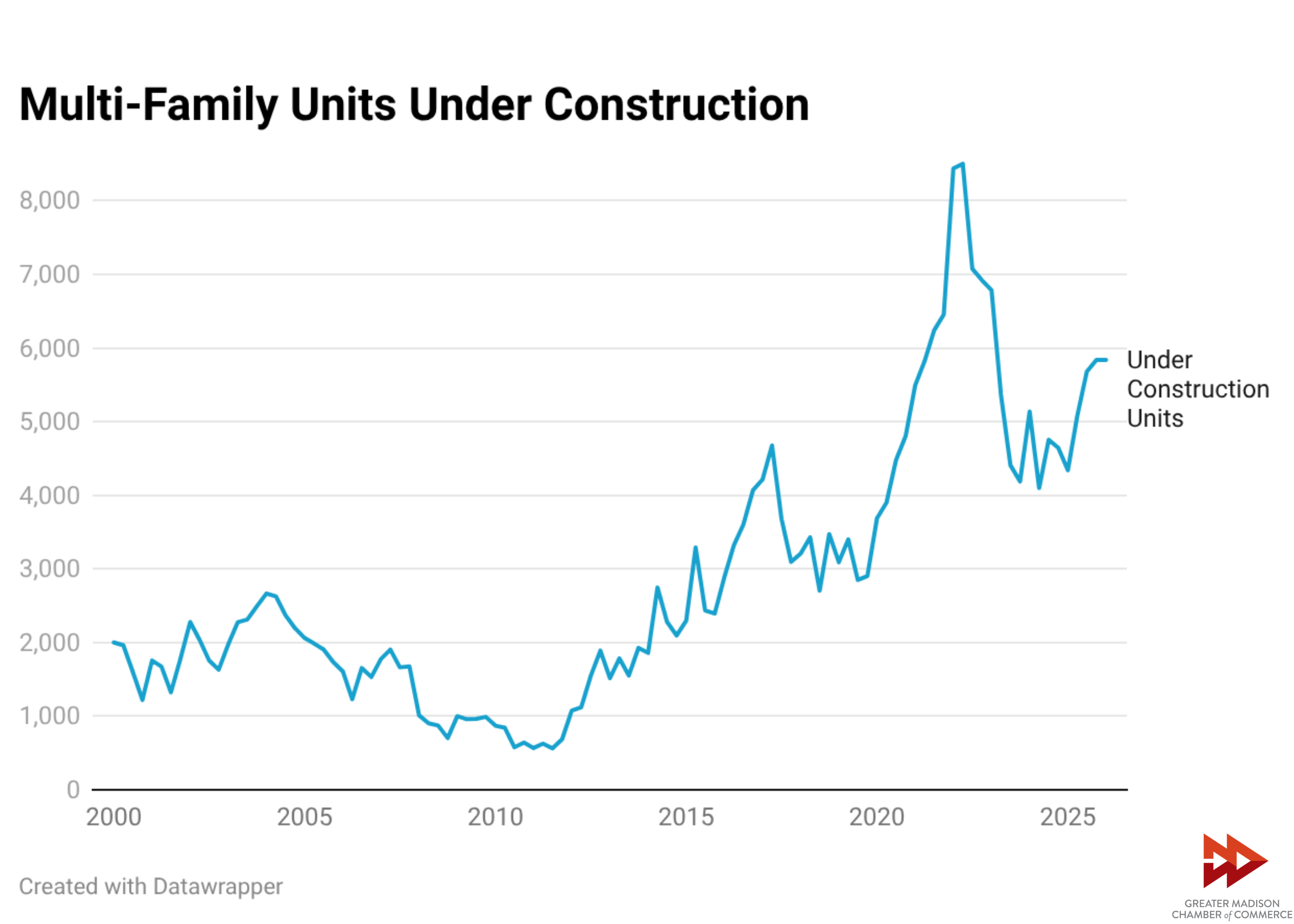
CoStar reports there are 5,837 multifamily housing units currently under construction in the region (Fig. 2). This figure is higher than at any point before the pandemic but remains below the peaks recorded in 2021 and 2022. Overall, there is a strong upward trend in number of units under construction.
Single-Family Home Sales
The Wisconsin REALTORS® Association recently released their December 2025 report, which included data on single-family home sales in all Wisconsin counties. According to the report, the Madison Metro market grew over the past year. Columbia, Dane and Green counties saw increases in sales. Iowa County was the only county in the metro to experience a decline.
Benchmarking Progress
The City of Madison has a housing tracker on its website with valuable information about the quantity and type of housing that is being built within the city. Madison leaders set a goal to build 15,000 new housing units by 2030, an average of 3,000 units per year. Last year the city added a net 2,328 housing units, slightly less than the target number. Currently, 5,320 units are under construction.
An additional data point is the Dane County Regional Housing Strategy 2024 Annual Metrics Report. This report is based on a survey of Dane County municipalities regarding their activities in the 2024 calendar year. The report found that seven of 12 municipalities had affordable housing funds, which the strategy defined as a key need in the region’s housing market. The report also found that 700 affordable housing units were funded in Dane County in 2024 (out of the 1,765 the report set as an annual target) and that 172 affordable senior housing units were funded (out of the 700 the report set as an annual target).
The strategy includes a target number of 7,000 total housing units per year in Dane County. In 2024, 5,477 housing units were permitted county-wide. Though an increase from 2023, the number of housing units permitted still misses the strategy’s goal. The report “illustrates both early momentum and the scale of work still required,” a statement which applies not just to Dane County’s housing market but also the entire region.
Fig. 1
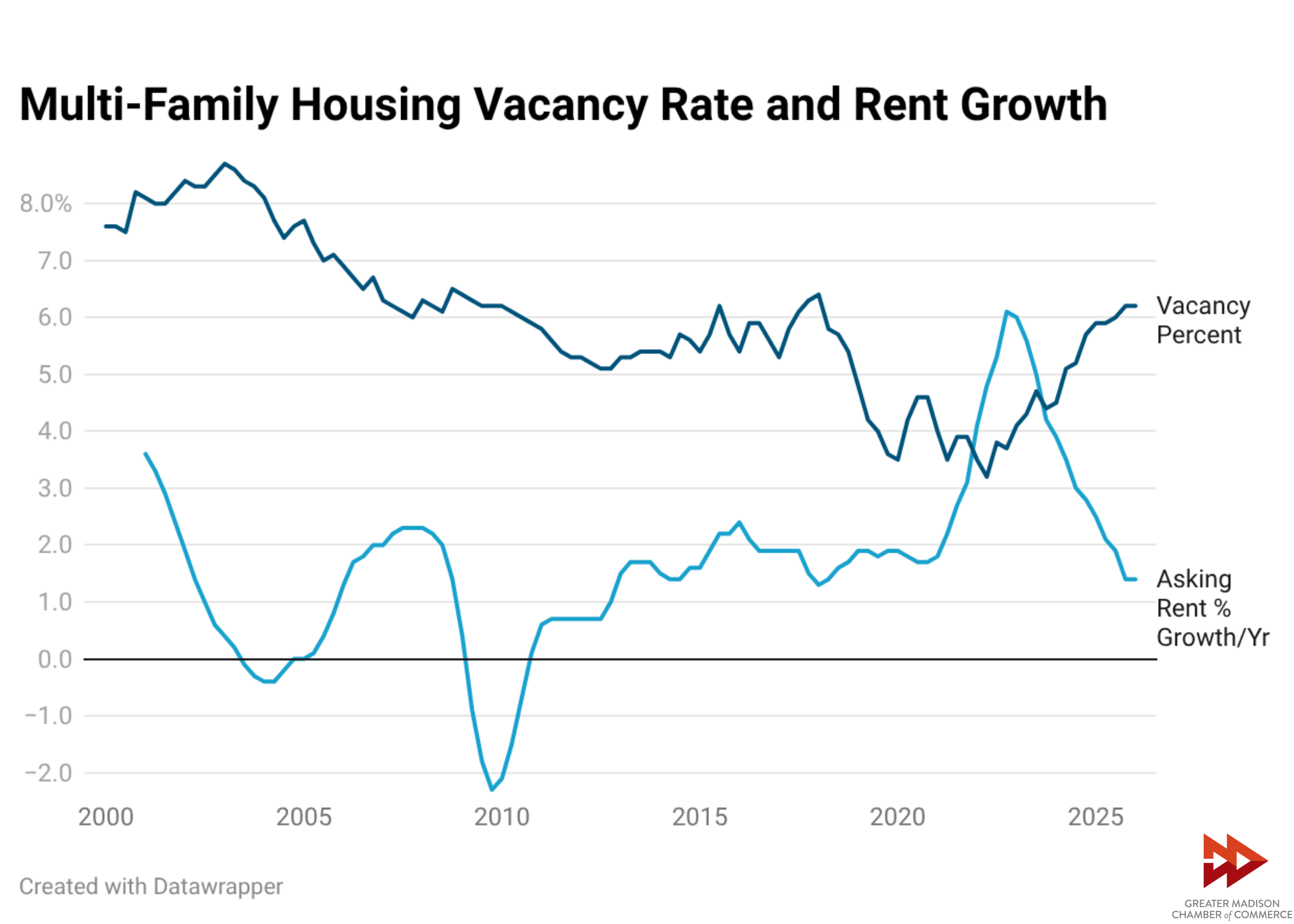
Fig. 2